
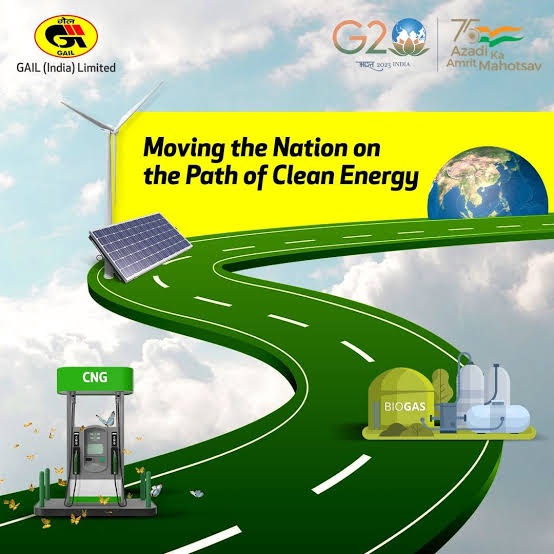
GAIL : Enhancing quality of life through clean energy

An Interview with R. K. Singhal
Director (Business Development) | GAIL (India) Limited
What is your assessment on the current situation of gas industry in India?
India’s natural gas sector is at an inflection point after almost decade of slow growth, with 10-yr CAGR from FY2013-14 to FY 2022-23 being only 1.5%, while the same increasing to 3.32% and 3.58% in FY 2023-24 and FY 2024-25, respectively.
India ranks 11th globally in natural gas consumption and is the fastest-growing major market. As the world’s fourth-largest LNG importer, India relies on imported LNG for nearly half its gas needs, making it vulnerable to geopolitical disruptions such as the Russia–Ukraine conflict and instability in the Middle East, which have caused LNG price volatility and trade-route risks. Despite this, domestic gas demand has trended upward, although competition from alternative fuels-including low-priced imported LPG-has recently tempered consumption. On the supply side, declining output from ONGC and OIL’s legacy fields and modest KG Basin additions have constrained domestic availability. The government has responded with major reforms-HELP, OALP, gas-pricing liberalisation, and opening previously restricted exploration areas—to stimulate production.
Demand has been buoyed by the fast-growing city gas sector, which now accounts for over 20% of consumption, alongside refineries, petrochemicals, and industry. Infrastructure expansion has been substantial, including an eightfold increase in CGD areas, pipeline growth to over 25,000 km, and LNG regas capacity rising to 52.7 MMTPA. To reduce import dependence and support decarbonisation, the government is promoting CBG and other cleaner fuels. Bringing natural gas under GST could significantly improve affordability and demand. Overall, natural gas remains a critical transition fuel, though import dependence will persist.
Where does Indian gas sector stand compared to the international gas sector?
Natural gas maintained a 23% share of global primary energy in 2024, reaching a record 149 EJ, with demand growth led by emerging economies, underscoring its continued role as a key transitional and balancing fuel.
India’s natural gas share is only 6.5% versus the global 25%, yet it is the fastest-growing major market, importing 37.9 BCM LNG and ranking 11th in consumption and 4th in LNG imports.
India’s gas use rose to 195.3 MMSCMD in FY25, driven by industry, CGD, and higher domestic output, while LNG imports remained strong; globally, scenarios show gas retaining importance, especially in fast-growing economies.
Which are the thrust areas for gas sector in India?
As India pursues climate commitments and energy security, natural gas is envisaged to increase its share in the primary energy mix from ~6.2% to 15% by 2030. Key thrust areas include:
- Gas Infrastructure Expansion: Development of the National Gas Grid with over 25,000 km of operational pipelines and more than 10,000 km under construction, alongside expansion of LNG terminals and storage to improve connectivity and supply security.
- City Gas Distribution (CGD) and Mobility: Rapid rollout of PNG and CNG networks across 300+ geographical areas, with over 1.5 crore domestic PNG connections and 8,428 operational CNG stations (as of Sept 2025), supporting cleaner urban energy and transport.
- Industrial Decarbonization: Increased use of gas in fertilizers, petrochemicals, steel, and power generation to reduce emissions, supported by policy reforms, unified tariffs, and marketing freedom.
- Renewable Integration and CBG: Promotion of compressed biogas under SATAT and blending mandates to support a circular economy and rural income.
What is your business mission & vision?
GAIL’s Mission: – Enhancing quality of life through clean energy and beyond
GAIL’s Vision: Be the leader in natural gas value-chain and beyond, with global presence, creating value for stakeholders with environmental responsibility
What is the potential for future growth?
GAIL’s future growth is anchored in Strategy 2030, combining core natural gas expansion with diversification into clean energy and petrochemicals. Infrastructure remains central, with 2,000 km of new pipelines under construction and a strengthened LNG portfolio exceeding 16.5 MMTPA, supported by Qatar-sourced volumes and the now all-weather Dabhol terminal. Petrochemical growth is driven by major projects such as the Usar PDH-PP plant, Pata PP expansion, and a 1.25 MMTPA PTA unit through GMPL. GAIL is also advancing alternate fuels via coal gasification JVs and expanding CBG initiatives. On the clean energy front, GAIL plans to ramp up its renewable energy capacity to ~3.5GW from the current 145MW.
What differentiates your business from its competitors?
GAIL’s strength lies in its fully integrated presence across India’s natural gas value chain. It operates the country’s largest transmission network—~18,000 kms, expanding to 20,000 kms by 2026—transporting over 120 MMSCMD, alongside marketing volumes of ~101.5 MMSCMD. Its diversified 16.5 MMTPA LNG portfolio, supported by five owned LNG vessels, enhances supply security and cost optimisation. Petrochemical capacity is set to triple with major projects such as the Usar PDH-PP plant and GMPL PTA unit. GAIL also leads in green hydrogen and biogas, commissioning India’s first 10 MW PEM electrolyser and a commercial CBG plant. This integrated scale positions GAIL as a strategic industry leader.
What are your marketing and growth strategy?
GAIL’s marketing and growth strategy centers on strengthening its gas value-chain leadership while expanding into clean energy. With ~101.5 MMSCMD of marketing volumes and diversified LNG sourcing, including a mid-term Qatar deal, it ensures supply resilience. Nearly 2,000 km of new pipelines—such as MNJPL and SAPL—advance the One Nation One Gas Grid vision, while CGD operations now serve 99 lakh PNG households and 3,151+ CNG stations. Petrochemical capacity will nearly triple by 2026, complemented by LPG pipeline expansion. GAIL is also scaling renewables, green hydrogen, CBG, and coal-to-SNG ventures. Together, these initiatives strengthen growth, competitiveness, and alignment with India’s decarbonisation goals.
What are the main risks that could impact your business?
GAIL faces several risks driven by regulatory shifts, global LNG volatility. Uncertainty in pipeline and tariff frameworks, along with delays in GST inclusion, can affect pricing and competitiveness. External risks stem from fluctuating LNG markets, geopolitical disruptions, and currency movements, despite diversified sourcing and long-term contracts. Petrochemical operations face feedstock cost volatility and demand fluctuations. Large-scale pipeline, petrochemical, and clean energy projects also carry execution risks. Additionally, emerging alternative fuels may reshape demand. GAIL mitigates these challenges through diversification into renewables, biofuels, and hydrogen, supported by a strong enterprise risk management framework ensuring resilience and sustainable growth.
By what percentage do you intend to grow and by when?
GAIL targets sustained high single- to low double-digit growth, supported by rising pipeline throughput and record marketing volumes. Petrochemical capacity will nearly triple to ~2.9 MMTPA by 2026, outpacing industry growth. Clean energy expansion-including renewables, hydrogen, and coal-to-synthetic gas-supports its Net Zero 2035 pathway. Strong financial performance, including a 28% rise in FY25 PBT and over ₹10,500 crore in capex, underpins this transition. Overall, GAIL aims to exceed sector growth while building a resilient, diversified, low-carbon energy portfolio.
What are your growth milestones?
GAIL’s growth milestones span infrastructure, diversification, and sustainability. Pipeline expansion of nearly 2,000 km will raise the network to 20,000 km by 2026, supported by major projects such as MNJPL and SAPL. LNG milestones include expanding Dabhol Terminal to 6.3 MMTPA and operating five LNG vessels. Petrochemical growth is anchored in commissioning the Usar PDH-PP and Mangalore PTA plants by 2026. New energy milestones include CBG scaling and the 10 MW Vijaipur green hydrogen plant. Achieving Net Zero (Scope 1 and 2) by 2035 and digital programs such as SAP S4 HANA strengthen operational excellence and long-term sustainability.
What additional resources will be needed to support growth?
GAIL’s growth ambitions require strong policy support alongside capital, technology, and talent investments. Key measures include placing natural gas under the lowest GST slab, rationalizing state VAT, and reducing GST on LNG and CNG vehicles to enhance affordability. Policies supporting LNG-based mobility, gas-based power through emission-weighted merit order, and mandating gas use in steelmaking would significantly boost demand. Fiscal incentives-capital subsidies, concessional financing, and carbon-market integration-are essential for pipelines, LNG terminals, and clean energy projects, enabling GAIL to accelerate India’s gas-based energy transition.
What will be the future strategy of GAIL?
GAIL’s future strategy aligns with Strategy 2030 and focuses on two priorities: strengthening its core gas value chain and expanding into low-carbon energy. Core initiatives include expanding the National Gas Grid to 20,000 km, deepening marketing volumes, optimizing a 16.5 MMTPA LNG portfolio, and supporting CGD networks serving 99 lakh PNG consumers and 3,150+ CNG stations. Diversification will see petrochemical capacity grow to ~2.9 MMTPA, alongside scaling renewables, green hydrogen, CBG, coal-to-SNG, ethanol, and CO₂ valorisation. Guided by a Net-Zero 2035 target, GAIL will leverage digitalisation, R&D, and governance to ensure resilient, profitable, clean-energy growth.
(Shilpa Bichitra | Special Edition | 2025)
Categories
-
Agriculture & Rural Development11
-
Banking & Insurance4
-
Coal & Mines5
-
Defence & Defence Production5
-
Engineering & Technology3
-
Environment & Pollution1
-
Export & Import1
-
Housing & Urban Development1
-
Human Resources & CSR Initiatives2
-
Iron & Steel3
-
Logistic & Warehousing2
-
Micro, Small & Medium Enterprise3
-
Petroleum & Natural Gas8
-
Post & Telecommunication3
-
Power & Energy4
-
Tourism & Leisure2