

Special Story : Play Based Exploration

By Rajesh Kumar Srivastava | Director (Exploration) | Oil and Natural Gas Corporation Limited
Exploring for oil has essentially been about delving into the recesses of an explorationists’ mind to unlock the mysteries of the subsurface. From the earliest forays to a couple of decades back, the era belonged to that of locating large structures. But the law of diminishing returns ensured that the emphasis shifted to subtle traps and stratigraphic entrapments. ONGC, in its more than six decades quest for oil has gleaned an in depth knowledge of the various petroliferous Basins of the country but incessant rise in energy demands has brought us to a juncture where a paradigm shift in the adopted exploration philosophy was necessary. Globally, an approach towards Play Based exploration in the last decade has yielded success in old as well as new Plays and the need to migrate from traditional methods of prospect evaluation to a regional Play based Exploration (PBE) was strongly felt. Concerted efforts since then have seen major Basins move towards this approach and this analysis highlights an example of how the largest producing Basin has adopted this technique.
What is a Play: A Play may be defined as a regionally extensive reservoir-seal pair with a unique spatial and temporal arrangement conducive for hydrocarbon charge and retention within a hierarchical sequence stratigraphic framework.What Play based exploration does, is to shiftemphasis from “Prospect based exploration” to a Play based one since a play and not a prospect is the basic unit of exploration. Having quoted that, mature basins are in an advantageous position to integrate legacy as well as state of art data to arrive at the Play Maps. Accumulated knowledge in a Basin therefore forms the bedrock of PBE, wherein Sequence Stratigraphic Framework, Tectonic evolution, Petroleum systems are already established. Consequent to this, Play based explorationcan then be taken forward, founding it on the “Exploration Pyramid”.
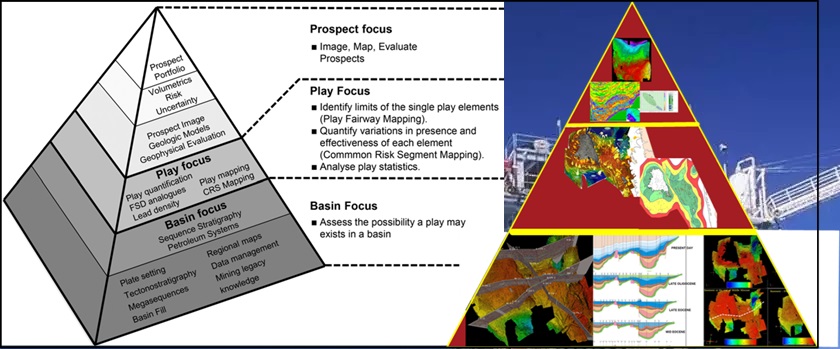
The Exploration or PBE Pyramid holds the key to adopting a Play based exploration methodology in a basin. It builds from the basin to prospect scale through the principles of play based exploration.The base of the Pyramid provides the regional and tectonic framework and an understanding of petroleum systems. Which then forms the foundation on which each play can be analyzed and integrated into the overall petroleum system, through “Play Fairway Mapping”. Play analysis hinges on quantifying each element of the system within a particular play, through usage of Common Risk segment or CRS maps to highlight areas of interest as well as areas of risk.
PBE Methodology: Basin Focus as the Foundation
- Basin characterization, Tectonostratigraphic framework and Sequence analysis: The tectonic setting of a basin exerts primary control over its architecture, sedimentation and reservoir presence, source rock distribution and maturation history. Play based exploration builds upon this knowledge and thereforeidentifying major Sequences and their boundaries forms a preamble to play based analysis.
- Basin evolution, source rock, reservoir and seal distribution: Mapping the basin evolution through a series of paleogeography maps, which depict creation of accommodation space, resultant facies and distribution of source/reservoir/ seal arising from that facies.
- Assess petroleum system: Integrate hydrocarbon occurrence data, including oil to oil and oil to source correlations, assess charge timings and critical moment.
- Trap Distribution: Mapping the timing of structural development which signifies an understanding of trap timing and trap size distribution.
- Identify Plays.
Play Focus:
- Play Definition: Defined by stratigraphy, a play map should reflect all possible details of current geological understanding. Since play boundaries are commonly determined by a regional unconformity or a maximum flooding surface, play elements are likely to change from one sequence to the next.
- Play Summary Maps: Prepare play element maps of reservoir, charge and entrapment, which explains the drilling history of a basin, especially with reference to dry wells. For each element of the petroleum system, a map of boundaries is made, to define the geology that may decide success or failure of that particular factor. This aids in creating a framework to interpret Play boundaries, estimate chance of success and assign risks.
- Common Risk Segment (CRS) mapping and Risking: CRS mapping and risking follows Play element mapping and uses the boundaries set in those maps. Play and prospect level maps for Reservoir, Charge and Entrapment are used to describe risks as High, Medium or Low, which are then stacked to prepare Composite CRS maps.
A similar work flow was recently adapted for the most prolific basin in India, and a brief outline of the case study is presented here.
Case Study: Mumbai Offshore Basin
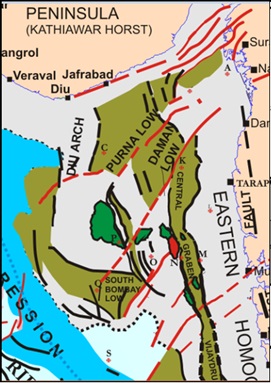
Mumbai Offshore Basin, a pericratonic rift basin in the western continental shelf of India, covers about 1,48,000 km2 from coast to 200m isobaths with a sedimentary fill ranging from 1100 to >5000 m. Numerous large oil and gas fields have been discovered in this basin, and presence of hydrocarbons is proven in the entire stratigraphic column of Tertiary age, as well as in the granitic and basaltic Basement. The basin accounts for nearly two-thirds of the annual petroleum production of India and the Established Petroleum system is that of (i) Paleogene-Paleogene and (ii) Paleogene-Neogene. Primary source rocks are the Late Palaeocene-Early Eocene clastic sediments of Panna Formation with thicknesses > 1000 m.
Play Analysis of all six major Plays of the Basin was carried out, wherein each play maps integrated available sedimentary, biostratigraphy, geochemistry data and Regional understanding of tectonics. The resultant maps brought together the Reservoir presence, Source presence, hydrocarbon pool limits within a Play and Regional fault systems to highlight promising areas for play based exploration.
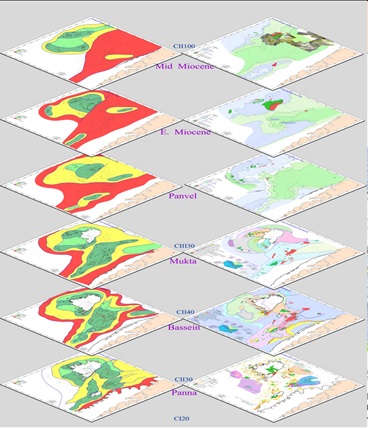
The maps thus prepared were ranked for prospectivity and Resource data calculated through PSM was assigned sector wise, resulting in “Play Risk Maps” which depict prospect risk on a regional or basin-wide scale.
Methodology adopted in the case study:
- Analysis of source rock data to map source rock pods, in both spatial and temporal domains and draw oil to source correlations across the Basin.
- Identification of the fault systems, their evolution through geological time, and categorization based on genesis of the faults.
- Integrate oil to source data with the mapped fault system to establish most likely play fairways.
- Prepare detailed Pale geography maps for each play and incorporate in them, source/ reservoir/ seal presence.
- Prepare Play Summary or Play Dynamics maps integrating Fault network and hydrocarbon pools for each Play.
- Mapping of the entrapment pattern on a Regional scale. Analyse the hydrocarbon accumulation trends, and identify probable dry and wet corridors.
- Prepare Play risk maps and identify promising areas for play based exploration.
- Analyse basin and play resources and assigning yet-to-find volumes to different part of the basin to prioritize blocks for exploration.
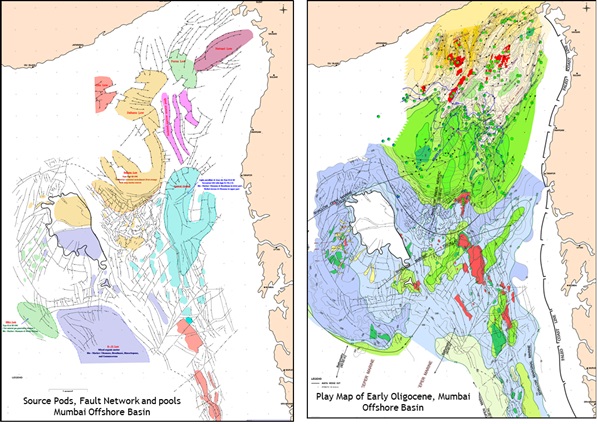
Since the Bombay petroliferous provinceis the result of an intricate relationship between tectonics related to the rifting, drift and collision of the Indian Plate, understanding the evolution of the Basin and its petroleum system formed the base of the PBE pyramid.
The second rung of the pyramid which is the Play Focus, integrated sedimentation history maps with faults and pool distribution showing how reservoir and pool distribution moves through time and space.Play wise Risk maps demonstrated the Risk in each play, and when stacked, it established areas of minimal exploration risk.
The study was an attempt to bring the history of the Basin, its present status and future exploration areas on a common platform and the Play Focus maps can next be used as a template to move to the vertex of the PBE pyramid, which is the Prospect focus, bringing to fruition a Play based approach in a mature basin.
Conclusion: Implementing a Play based method to exploration has some obvious advantages since it lays down a framework for systematic exploration with a consistent risking methodology. This in turn helps to allocate resources optimally. Future strategic decisions on whether to opt for low risk-high reward in the short term or to alternate with Moderate Risk-High reward for future growth are easier taken with the help of a Play based exploration approach.
(Shilpa Bichitra | Special Edition | 2020)
Categories
-
Agriculture & Rural Development11
-
Banking & Insurance4
-
Coal & Mines5
-
Defence & Defence Production5
-
Engineering & Technology3
-
Environment & Pollution1
-
Export & Import1
-
Housing & Urban Development1
-
Human Resources & CSR Initiatives2
-
Iron & Steel3
-
Logistic & Warehousing2
-
Micro, Small & Medium Enterprise3
-
Petroleum & Natural Gas6
-
Post & Telecommunication2
-
Power & Energy3
-
Tourism & Leisure2